
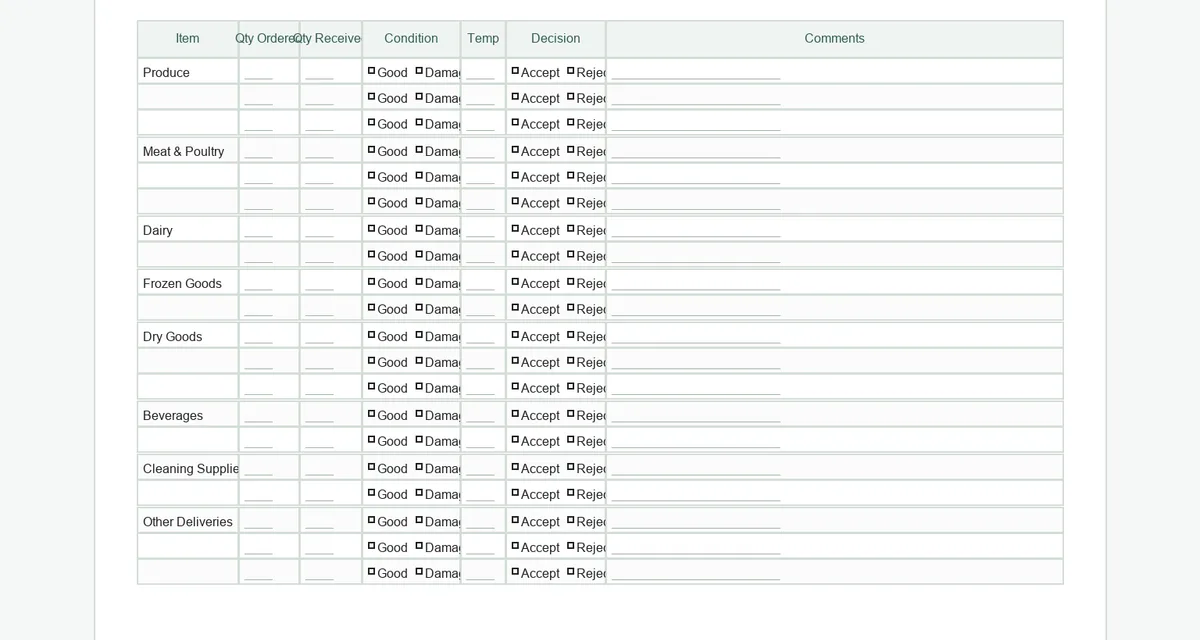
Supplier deliveries are one of the most important control points in restaurant operations. Every delivery can affect food quality, stock accuracy, cost control, and service reliability. When receiving is rushed or inconsistent, small mistakes compound quickly. A few undocumented shortages, an unchecked temperature, or a damaged package that was not recorded can lead to spoilage, menu disruptions, and difficult supplier conversations later.
That is why a structured supplier delivery log is so valuable. It gives teams a clear process at the exact moment inventory enters the business. Instead of relying on memory or informal notes, staff capture what arrived, how it arrived, and whether it was accepted or rejected. This simple discipline protects both daily service and long-term operational quality.
Why receiving control matters more than most teams realize
Many restaurants focus heavily on prep, service, and closing tasks while receiving remains semi-formal. In busy periods, deliveries are often checked quickly and moved into storage immediately. If documentation is weak at this stage, the team loses visibility from the beginning.
Receiving errors usually appear later as symptoms:
- Inventory count mismatches
- Unexpected stockouts
- Higher food cost variance
- Product quality complaints
- Waste from unusable items
- Unresolved supplier disputes
When the original delivery details were never recorded properly, diagnosing the cause becomes difficult. A delivery log creates traceability, and traceability is what allows operators to solve recurring issues rather than repeatedly react to them.
The operational value of a delivery log
A good delivery log should do more than record item names. It should support the real decisions staff make at receiving:
- Was the quantity received correct?
- Was the condition acceptable?
- Was temperature appropriate where relevant?
- Was the item accepted or rejected?
- If there was a problem, what corrective action was taken?
These details create a practical audit trail. Managers can review trends, owners can monitor supplier reliability, and teams can follow up with evidence instead of assumptions.
Better supplier conversations through better records
Supplier relationships improve when restaurants keep clear records. If a team can document shortages, condition issues, or repeated quality concerns with dates and invoice references, conversations become more constructive. Rather than vague complaints, the business can provide specific examples.
That helps with:
- Credit requests and returns
- Repeat issue escalation
- Delivery expectation alignment
- Contract and pricing discussions
Accurate logs protect both parties by reducing ambiguity. Over time, this often leads to fewer disputes and faster resolutions.
Food safety and accountability benefits
For food-service operations, receiving is a food safety checkpoint. If a restaurant does not record what arrived and in what condition, risk increases. Logs encourage teams to pause, inspect, and verify before storing products.
Even when regulations differ by region, consistent receiving documentation helps restaurants demonstrate that controls exist and are actively used. For many operators, that confidence is essential during internal reviews, inspections, or staff handovers.
Logs also improve accountability. When header fields include who received the delivery and which shift handled it, follow-up becomes clearer. Managers can coach process gaps more effectively, and teams know that receiving standards are shared expectations.
Why section-starter layouts work in real kitchens
Many forms fail because they either over-prescribe every row or feel too empty to guide staff. A section-starter structure solves this by combining direction and flexibility. The first row names the category, while follow-up rows remain open for the actual items delivered that day.
This approach works well in receiving because delivery contents vary. One day a supplier may send multiple produce lines, another day mostly frozen and dry goods. Staff can continue writing naturally without fighting the template, while still keeping records organized by operational area.
A practical implementation standard
Restaurants that want stronger receiving control should keep the process simple and repeatable:
- Use one standard supplier delivery log for all receiving shifts.
- Record supplier and invoice details before item checks begin.
- Verify quantities and condition line by line.
- Mark accepted or rejected immediately at the point of inspection.
- Document issues and corrective action before filing the sheet.
- Review logs weekly for recurring supplier or process patterns.
Consistency is more important than complexity. A clean one-page log used every day outperforms complicated systems that teams avoid.
Supporting operations without adding friction
The best operational templates reduce mental load. Staff should be able to pick up the sheet and know exactly what to do without extra explanation. That is why clear headers, readable columns, and print-friendly spacing matter. These design details are not decorative; they directly influence completion quality during busy service windows.
For teams that want to tighten receiving accuracy, a professional printable Supplier Delivery Log is a practical step. It provides the structure needed for auditable records while remaining flexible enough for real delivery variation.
If your current receiving process relies on memory or scattered notes, this is one of the highest-leverage forms you can standardize. Better receiving records lead to better inventory control, cleaner supplier communication, and more reliable daily operations.