
Food waste is one of the most common hidden costs in restaurant operations. Even teams with strong service and prep routines can lose margin each week when waste is not tracked consistently. A tray of overproduced items, expired stock, or repeated quality issues from one supplier may seem minor in isolation, but those losses compound quickly.
The challenge is not just waste itself. It is the lack of usable records. Without a clear daily tracking method, managers can see that food cost is high, but they cannot pinpoint why losses keep repeating.
Why food waste tracking matters
Most restaurants operate on tight margins. Small improvements in waste control can create meaningful financial impact over time.
When teams track waste daily, they can:
- Spot overproduction patterns by shift
- Identify repeated expiry losses by category
- Detect handling or storage issues earlier
- Improve purchasing decisions with better evidence
- Strengthen prep planning and portion control
This turns waste management from guesswork into a practical operating process.
Common causes that go unnoticed
In many kitchens, waste happens fast and gets recorded inconsistently. Teams may note issues informally, but details are lost between shifts.
Frequent causes include:
- Expired stock
- Damaged deliveries or packaging
- Spoilage from storage failures
- Overproduction during prep
- Customer returns
If those causes are not logged in a structured format, recurring issues remain invisible and cost-control conversations stay vague.
Why compact checkbox-based waste logging works
A good operational template should be fast to complete in real working conditions. Long free-text fields for every entry often reduce completion rates.
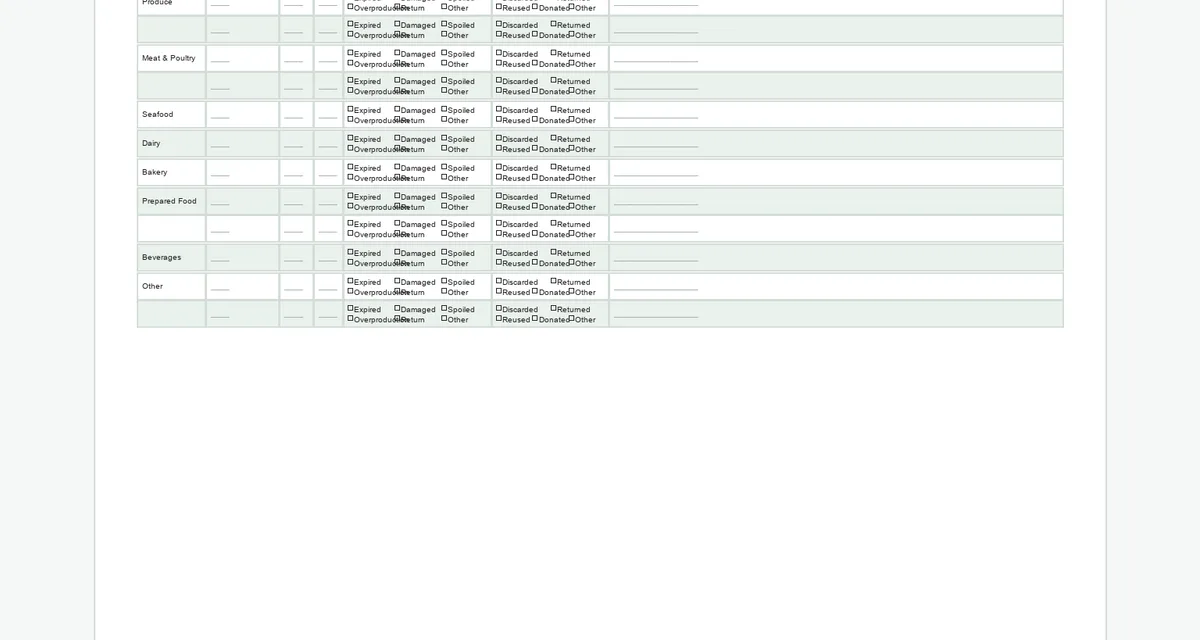
A compact checkbox-based approach for reason and action keeps logging practical:
- Staff can choose one clear reason and one action in seconds
- The form remains readable even during busy service windows
- Manager review is faster and clearer
- Trends are easier to identify during weekly reviews
Teams still keep flexibility through comments and quantitative columns, but the core decisions become consistent.
Section Starter layout improves usability
Waste tracking forms often fail when they are too rigid or too open. The Section Starter structure balances both needs.
Each category appears once on the first row, followed by blank continuation rows. This gives staff clear category guidance without forcing merged cells or repetitive labels.
For restaurant teams, this means:
- Faster completion
- Better readability
- Cleaner handovers
- More useful records for management
Turning records into action
A waste log is most valuable when teams review it regularly.
A simple weekly review process can include:
- Identify top three recurring waste reasons.
- Check which categories contribute the highest volume.
- Review action choices used most often.
- Record corrective actions and assign owner follow-up.
- Track whether repeat issues decline next week.
This creates an improvement loop, not just a filing exercise.
Operational and compliance benefits
While a waste log is mainly a cost-control tool, it also supports broader operational discipline. Clear records improve accountability across shifts and help managers verify whether issues are being addressed.
For multi-role teams, this matters:
- Owners get clearer cost signals.
- Kitchen managers get practical decision data.
- Supervisors get a structured daily workflow.
- Staff get a form that is easy to use under time pressure.
A practical next step
If your restaurant still tracks waste informally, standardizing one daily log is a high-leverage change. You do not need a complex software rollout to start improving. A one-page printable process can immediately increase visibility and reduce repeat losses.
Consistent food waste tracking helps teams protect margin, improve planning, and build stronger operational habits over time.